
On July 4th, 2025, the One Big Beautiful Bill Act (OBBB) was signed into law. Like most sweeping legislation, it covers a lot of ground. But for multifamily investors, one provision stands out as especially impactful: the return of 100% bonus depreciation.
For property acquired and placed into service between January 20th and December 31st of 2025, investors can now deduct the full value of qualifying components in year one. This change is more than just a technical adjustment to the tax code; it’s a powerful tool for accelerating returns and improving cash flow from day one.
If you’ve been thinking about getting into multifamily this year, this matters. The timing of your acquisition could mean the difference between an average deal and a highly efficient one. But what exactly is bonus depreciation, and how big of a deal is this change? Let’s walk through it.
What Is Bonus Depreciation?
Bonus depreciation is a special tax rule that allows an investor to write off the full cost of certain assets all at once, rather than spreading that deduction out over many years. Without it, some components would be depreciated over 27.5 or even 39 years. With bonus depreciation in place, qualifying purchases can be deducted immediately, delivering a much larger benefit in year one.
This depreciation doesn’t apply to the building itself or the land it sits on. It applies to personal property, things like appliances, carpets, landscaping, and certain improvements. It also includes land improvements with a useful life of 20 years or less and something called Qualified Improvement Property (QIP), which covers many types of non-structural interior upgrades to commercial buildings.
When a syndication is formed to acquire an existing multifamily property, this type of depreciation becomes a powerful multiplier. At Growth Legacy Capital, we focus on value-add investments: buying properties that need improvements, making those improvements, and increasing the income they generate. Bonus depreciation accelerates the benefits of that strategy. The general partners typically order a cost segregation study, which breaks down the purchase into separate asset classes. That allows us to identify what can be written off right away, and pass those savings directly to investors.
Bottom line, what does this mean for investors?
1. Your taxable income is reduced (possibly even to 0).
2. You pay less in taxes.
3. Greater cash flow in year one.
A Short History of Bonus Depreciation
Bonus depreciation hasn’t always been available, and it certainly hasn’t always worked the way it does today. When it was first introduced, it was a much narrower tool that mainly benefited developers of new construction.
The idea was born in 2002 with the Job Creation and Worker Assistance Act, which allowed investors to take 30% bonus depreciation on new property. At the time, used properties didn’t qualify at all. Over the years, the percentage of bonus depreciation has changed multiple times. It has risen, fallen, disappeared, and returned once again. Perhaps the most impactful shift happened less than a decade ago, when legislation expanded the benefit to include used properties for the first time.
Here’s how the bonus depreciation rules have evolved over time:
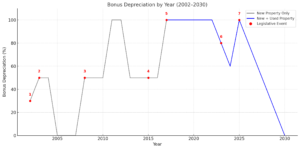
And here’s a summary of the major legislative milestones that shaped those changes:
- 2002 Job Creation and Worker Assistance Act: Introduced 30% bonus depreciation for new property.
- 2003 Jobs and Growth Tax Relief Reconciliation Act: Increased bonus depreciation to 50%.
- 2008 Economic stimulus laws during the Great Recession reinstated 50% bonus depreciation to spur investment.
- 2015 PATH Act: Made bonus depreciation more predictable, with a scheduled phase-down.
- 2017 Tax Cuts and Jobs Act (TCJA): Increased bonus depreciation to 100% and, for the first time, allowed it to apply to used property.
- 2023 TCJA’s original schedule began phasing out the 100% rate, dropping to 80%.
- 2025 One Big Beautiful Bill Act (OBBB): Reinstated 100% bonus depreciation for property placed in service between January 20 and December 31, 2025, and kicked off a new phase-down starting in 2026.
This context helps clarify just how valuable 2025 is for multifamily investors. We’re in a moment that gives us the most generous version of this tax rule we’ve seen, and one that won’t last forever.
Real-Life Example
Let’s look at a real example of bonus depreciation at work. To keep things simple, we’ll use round numbers and conservative estimates. We’ll also compare what investors get today, under the restored 100% bonus depreciation, against what they would have received if the phase-down had continued as originally scheduled, and with no bonus depreciation at all.
Imagine you acquire a $5 million multifamily property. A cost segregation study reveals that $800,000 of the purchase price qualifies as short-life property eligible for bonus depreciation.
If the property is placed in service in 2025, here’s how the outcomes would differ depending on the bonus depreciation rules in effect:
| Scenario | Bonus Depreciation % | First-Year Deduction | Tax Savings (37% bracket) |
| Current (OBBB) | 100% | $800,000 | $296,000 |
| Without OBBB | 40% | $320,000 | $118,400 |
| No Bonus Depreciation | 0% | $0 | $0 |
In the current scenario, the investor can deduct the full $800,000 in year one, resulting in nearly $300,000 in immediate tax savings. That’s money that stays in your hands and can be reinvested, distributed, or used to fund renovations.
If the OBBB hadn’t passed and we were following the original phase-out schedule, that same investor would only be able to deduct $320,000 this year, leaving over $175,000 in unrealized tax benefit on the table. And in a scenario where bonus depreciation didn’t exist at all, the investor wouldn’t get any of this up-front benefit, instead spreading those deductions out over a decade or more.
That’s the difference bonus depreciation makes. And in a market where cash flow matters more than ever, it’s the kind of edge that can change the math on an investment entirely.
Conclusion
There’s a reason investors are paying close attention to 2025. The return of 100% bonus depreciation is one of the most impactful tax advantages we’ve seen in years. It rewards smart timing, amplifies the value of cost segregation, and puts more capital back in the hands of investors, right when it’s needed most.
At Growth Legacy Capital, we help software professionals build wealth through real estate that’s both tax-efficient and strategically positioned for long-term growth. If you’ve been waiting for the right moment to step into multifamily investing, this is it.
Let’s talk about how you can take full advantage of this window. Book a call and let’s build something that works for your future.
